
We live in an age of Christian pluralism. A new denomination springs up every day—or so it seems. And for us in America—propelled by our individualistic culture—it should come as no surprise that people are confused about Christianity.
My day job for the past seven years has been substitute teaching, and I had a student about a year ago announce, “I feel like Christianity has the most different branches of any religion.” I’m inclined to believe him. The prayer Jesus prayed in John 17 is no longer even on the average church leader’s radar because their plates are overflowing, working to unite their own dozen or so congregants so they do not leave for the church across the street or—worse—split and start yet another church/denomination.
In case you are unaware, listen to Jesus’ prayer:
“I do not ask for these alone, but also for the ones who are believing in me through their word, in order that all of them might be one, as you, Father, are in me, and I am in you, in order that they also might be in us, in order that the world might know that you sent me. The glory which you gave me I have given to them, in order that they might be one, even as we are one. I am in them, and you are in me, in order that they might be completed as one, in order that the world might know that you sent me and loved them even as you love me.”1
John 17:20–23
So, while Jesus states in John 17:9 that he “is not praying for the world,” this does not and cannot mean what you might have heard that it means. Jesus does not hate nonbelievers. Jesus does not hate the world. Jesus does not tell Christians to shun the world. John 3:16 should settle this debate once and for all: “God so loved the world!” But look at John 17:21–23 again. This passage makes it plain that God uses the visible unity of Christians to bring the world to saving faith. But Christians have made a sham of unity. The Nicene Creed declares, “[We believe] in one, holy, Catholic and Apostolic Church.”2 The Church is to be visibly one.3
Unfortunately, I do not believe denominations are going anywhere, and I am inclined to believe that unity might be more clearly demonstrated through denominations than it could be without them. But that is a book for another time. Right now, I want to look closely at a specific book of the Bible that provides a detailed description of Christians’ relationships both amongst themselves and with the world: 1 John.
The Purpose of John’s Letter
“[John] said many things, and nearly everything was about charity,” Saint Augustine wrote, introducing his preaching series on 1 John. He continues, “… so that we may all rejoice in one charity. Where there is charity there is peace, and where there is humility there is charity.”4
This sermon series was likely preached in 407 CE, and it is “the earliest extended work, whether in the form of sermons or commentary, on this book of scripture that has survived to our day.”5 As such, it behooves us to pay attention to Augustine’s understanding of this book (see below). I submit that if our handling of 1 John departs significantly from his understanding, we are mishandling this book of scripture. As Augustine explained, “Nearly everything was about charity … so that we may all rejoice in one charity.”6 Charity is an old-fashioned word for “love.”
Many commentators have put forward the argument that 1 John serves as a litmus test for true Christianity, and while there is some truth to this perspective, the reality is a bit deeper than this. John MacArthur7 explains the popular understanding:
While the gospel of John was “written so that [people] may believe that Jesus is the Christ, the Son of God; and that believing [they might] have life in His name” (John 20:31), 1 John was written to those “who believe in the name of the Son of God, so that [they might] know that [they] have eternal life” (1 John 5:13). By repeatedly cycling through the essential truths of Christianity, John, with increasingly deeper and broader disclosure, fortified his people against the assaults of the false teachers and reassured them that they possessed eternal life.8
While 1 John 5:13 is an incredibly clear statement of purpose, there are several other texts in 1 John that are equally clear. Daniel Akin explains, “First John provides several keys that allow us to unlock the specific purpose(s) of this epistle.”9 He then goes on to list these as follows:
- “We are writing these things in order that our joy might be made complete” (1:4).
- “My little children, I am writing these things to you in order that you might not sin” (2:1)
- “I wrote these things to you concerning the ones who are trying to deceive you” (2:26)
- “I wrote these things to you in order that you might know that you have eternal life” (5:13)
These are the four texts that Akin draws attention to,10 but he emphasizes 5:13, because it “brings together the other purpose statements in a unified theme.”11
Before evaluating Akin’s position, we must weigh two more (seven more?) statements of purpose in 1 John that Akin overlooked (2:12–14, 21).
- “I am writing to you, little children, because sins have been forgiven to you through his name” (2:12).
- “I am writing to you, fathers, because you have known the one from the beginning” (2:13a).
- “I am writing to you, young men, because you have conquered the evil one” (2:13b).
- “I wrote to you, children, because you have known the father” (2:14a).
- “I wrote to you, fathers, because you have known the one from the beginning” (2:14b).
- I wrote to you, young men, because you are strong, the word of God remains in you, and you have conquered the evil one” (2:14c).
- “I did not write to you because you do not know the truth, but because you do know it, and because every liar does not belong to the truth” (2:21).
Therefore, there are eleven stated purposes for this letter. Is it possible to unite them under one head? Is Akin—and others like John MacArthur (see footnote 8 above)—correct to emphasize 1 John 5:13?
John writes to fulfill joy (1:4). John writes to prevent sin (2:1). John writes to encourage believers (2:12–14, 21).12 John writes to warn of deceivers (2:26). And John writes to convince believers of their eternal standing (5:13). While there is some truth to the view that 5:13 summarizes all of these purposes, it has the unfortunate effect of turning the book of 1 John into an individualistic, introspective set of tests, which has the effect of turning Christianity into a self-effort religion.13
When we consider the fact that John actually says, “I wrote these things to you all in order that you all might know that you all have eternal life” (5:13), it bolsters the communal reality of 1 John that stands behind 1:4 (see the exposition scheduled for February 19). If one member of the community is failing to grasp that they have eternal life, then the whole community will suffer, and joy will not be complete. But John writes that “our joy might be made complete” (1:4). In this understanding, the “sin” of 2:1 is intimately related to cooperation within the community (something the deceivers of 2:26 are failing to do). And finally, John’s bullet list of encouragements in 2:12–14, and 2:21 all serve to bolster the purpose of 5:13. So yes, 1 John is a book of assurance, but according to John, true assurance is impossible apart from the Church.
Saint Augustine’s Setting
Saint Augustine ministered from 395–430 CE in Hippo Regius, North Africa (modern day Annaba, Algeria). One of his greatest opponents throughout his ministry was another Christian group: the Donatists. The Donatists became a distinct group in North Africa because of Emperor Diocletian’s14 persecution in the early fourth century CE.
During the persecution, Felix of Aptugni turned over “Bibles and church plate”15 to save his own skin. Later, Felix ordained Caecilian as bishop of Carthage in 311 CE, which became a point of contention. The thinking was, “If a traitor ordains a bishop, then the ordination is invalid and that bishop carries no authority.” Other North African bishops ordained Majorinus as a rival to Caecilian,16 and despite appealing their case to Emperor Constantine,17 the Catholics won, and Caecilian continued to be recognized as the only legitimate bishop of Carthage. The rival church was not dissuaded, though, and “by 313 this opposition was led by Donatus, who gave his name to the protest movement.”18 By the time Augustine was ordained Bishop of Hippo (395 CE), most Christians in this region were Donatists,19 so he naturally became embroiled in this conflict. Augustine was desperate to unite the Church, and his efforts went through three distinct phases (391–398; 398–405; 406–411).20 What began as attempts to convince the Donatists transformed, over time, into coercion. Augustine supported the use of political power to punish the Donatists for refusing to return to the flock of Rome.21
So what are we to make of this dispute? Tilley refers to the Donatists as “deviant Christians.”22 They were Christians. They were genuinely committed to following the teachings of the Bible. They were serious about sin. They were serious about the sacraments of the church. To say otherwise is to insist that all Protestants are unbelievers because we have committed the “unforgivable sin” of schism from the Roman Catholic Church. However, we cannot say this, because there is only one unforgivable sin (cf. Matthew 12:31–32), and there is no legitimate way to twist Jesus’ words to make it refer to schism. Rather, the ultimate trouble with the Donatists was their refusal to facilitate oneness with the Catholic Church.23
It is within this context that Saint Augustine gave his homilies on 1 John. He explicitly refers to “Donatists” or “Donatus” five times throughout the series, and he refers to them indirectly many more times.
While some commentators hesitate to propose the original context behind 1 John,24 given the context of Saint Augustine’s handling of the book—and the fact that his is the “earliest extended work”25 on 1 John—I believe a case can be made for interpreting it in a parallel fashion today. A schism had occurred, and it was up to John (and later Augustine) to encourage both those remaining to persevere in love and those who had left to return to love. We are dealing with a similar situation today. Exvangelicals. The deconverted. Pastors especially must walk this tightrope of reassurance and retrieval.
Unfortunately, Augustine was starting to settle into his coercive stage by the time he gave these homilies (407 CE). If we are to learn from history, and promote the Christian unity that Jesus desires, we must keep Augustine’s marriage of church and state as a flashing warning light before our eyes as we interpret his words. His strong-handed approach failed miserably—Donatism was only defeated when Islam spread to North Africa.26 We cannot afford to make the same mistakes he did.
Structure of 1 John
First John is not an easy book to outline. Calvin wrote that the book is not arranged in a “regular order.”27 Akin notes that “there are almost as many opinions as there are commentaries on the book.”28 The present study is no exception, offering yet another original outline for understanding the message of 1 John. (I will link future posts to the outline below for easy navigation.)
- The Main Argument (1:1–5:13)
- The Purpose of the Letter (1:1–4)
- The Community Rule (1:5–2:2)
- Tests of Fellowship (2:3–11)
- Specific Encouragements (2:12–14)
- Love of the World (2:15–27)
- God’s Children (2:28–3:10a)
- Love the Brothers (3:10b–18)
- Conscience (3:19–24)
- Testing the Spirits (4:1–6)
- Live in LOVE; Find Your True Reward (4:7–5:4)
- Jesus Christ (5:5–13)
- Conclusion (5:14–21)
- Prayer (5:14–17)
- Final Appeal: Cling to Truth (5:18–21)
It is worth noting that the first part of this outline ( I ) can be reformatted in chiastic structure.29 Chi is the Greek letter that looks like our letter X. Arguments structured this way move forward to a point, and then back up, covering similar ideas as they retreat. Typically, the main point of the whole argument is at the pivot point.
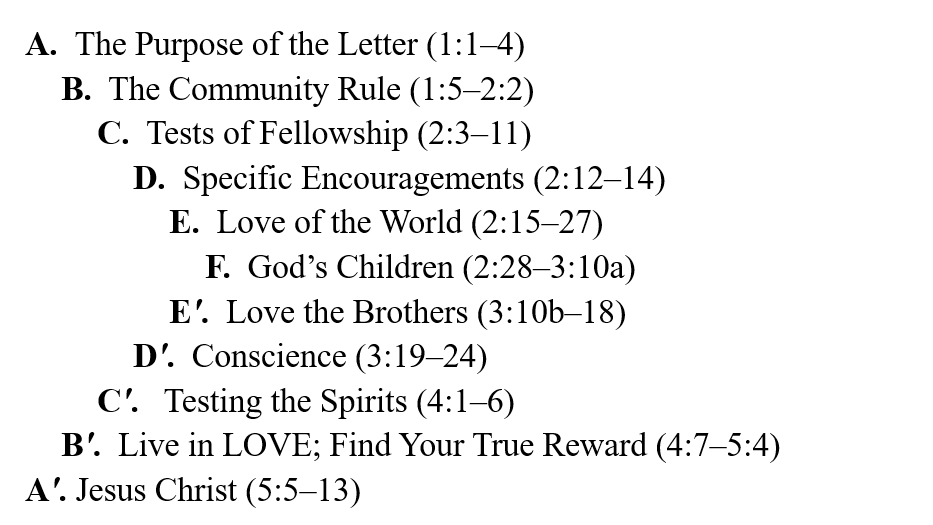
John’s first point is to emphasize the importance of the fellowship they should have with one another, a theme that weaves its way through the letter. He wants to encourage his readers that they are God’s children, reiterating that they belong to God, and warning them of the allure of the world. After strengthening his readers with this reassurance, John walks them backwards through his argument, now with a specific focus on bringing Christian fellowship to the lost world in need of salvation.
The Format of this Study30
Each chapter will follow the same pattern:
- Translated text
- Jump menu
- Textual Variants
- Exegetical details
- Exposition and Application
- Gospel Plea
- Great Commandment Plea
- Reflection questions
A Prayer
Lord Jesus,
As we enter the depths of 1 John, we plead with you to give us wisdom. Help us to not enter this study as a way to boost our minds and our pride. As Paul said, “Knowledge puffs up, but love edifies.”31 We long to be edified. We long to grow in love. We long for humility. “Blessed are the humble, for they shall inherit the earth.”32 The humble do not conquer the earth; they are given the earth by right after the arrogant powers that be destroy one another. Increase our love and help others to know your path of truth and love as a result. “All people will know you are my disciples, by your love for one another.”33 Strengthen your church to love faithfully into eternity. And make us quick to repent when we realize we have fallen short of your expectation. “Your will be done, on earth as it is in heaven.”34
In your perfect name we pray. Amen.
Thanks for reading!
In this with you!
While I am committed to providing theological reflections at no charge, your paid subscription makes my writing possible and helps me reach more people with the gospel of God’s love. If you’re not currently a paid supporter, please consider becoming a supporter today.
Buy Me a Coffee
Choose an amount
Or enter a custom amount
Your contribution is appreciated.
DonateNotes and References
- Unless otherwise noted, all Scripture translations are my own. The textual basis for New Testament passages in this study is Kurt Aland et al., Novum Testamentum Graece, 28th ed. (Stuttgart: Deutsche Bibelgesellschaft, 2012), including the textual apparatus within. When we get into the textual commentary (February 19 on 1 John 1:1-4), we will consider textual variants, but at this point, I am merely translating the text as it stands. ↩︎
- Philip Schaff and Henry Wace, eds., “The Second Ecumenical Council: The First Council of Constantinople,” in The Seven Ecumenical Councils, trans. Henry R. Percival, vol. 14, A Select Library of the Nicene and Post-Nicene Fathers of the Christian Church, Second Series (New York: Charles Scribner’s Sons, 1900), 163. Emphasis added. ↩︎
- Contra Gregg R. Allison, Sojourners and Strangers: The Doctrine of the Church (Wheaton, IL: Crossway, 2012), 177–178. If denominations were a biblical concept, then the council in Acts 15 would not have pursued unity; they would have let the Gentile Christians start their own denomination, separate from the Jewish Christians. ↩︎
- Saint Augustine, Homilies on the First Epistle of John, trans. Boniface Ramsey (Hyde Park, NY: New City Press, 2008), Prologue, pg. 19–20. ↩︎
- Boniface Ramsey, “Introduction,” in Homilies on the First Epistle of John (Hyde Park, NY: New City Press, 2008), 9–10. ↩︎
- Saint Augustine, Homilies on the First Epistle of John, Prologue, pg. 19. ↩︎
- Before February 19, 2025, I will publish a paid subscribers only article that introduces all of the commentators I might access in the course of this study. I start with MacArthur here, not to endorse, but to show that I am moving beyond him. In a revised version of my Galatians commentary, he will play a much smaller role. ↩︎
- John MacArthur, 1–3 John (Chicago, IL: Moody, 2007), 9. The brackets [] and capitalized divine pronouns are original. For other writers who emphasize tests for assurance as a primary point of 1 John, see James Montgomery Boice, The Epistles of John (Grand Rapids, MI: Baker, 1979); Alan England Brooke, A Critical and Exegetical Commentary on the Johannine Epistles, ICC (New York: T&T Clark, 1912); Colin G. Kruse, The Letters of John, PNTC (Grand Rapids, MI: William B. Eerdmans, 2000); John Stott, The Letters of John: An Introduction and Commentary, TNTC (Downers Grove, IL: InterVarsity Press, 1988). ↩︎
- Daniel L. Akin, 1, 2, 3 John, NAC (Nashville, TN: Broadman & Holman, 2001), 31. ↩︎
- Akin, 1, 2, 3 John, 31–32. ↩︎
- Akin, 1, 2, 3 John, 32. ↩︎
- This can be further broken down as follows: John writes to remind of forgiveness (2:12); prior knowledge (2:13a, 14b); spiritual victory (2:13b, 14c); spiritual belonging (2:14a); and the truth (2:21). ↩︎
- See Flame, “Sola Fide,” Extra Nos (St Louis, MO: Clear Sight Music, 2020), Spotify. ↩︎
- He ruled as emperor from 284–305 CE. ↩︎
- Henry Chadwick, Augustine of Hippo: A Life (Oxford: Oxford University Press, 2010), 98–99. ↩︎
- Maureen A. Tilley, The Bible in Christian North Africa: The Donatist World (Minneapolis, MN: Fortress Press, 1997), 10. ↩︎
- He ruled as emperor from 306–337 CE. ↩︎
- Chadwick, Augustine of Hippo, 99. ↩︎
- Matthew Levering, The Theology of Saint Augustine: An Introductory Guide to His Most Important Works (Grand Rapids, MI: Baker Academic, 2013), xv. ↩︎
- See Jeffrey A. Waldrop, “St. Augustine’s Doctrine for Understanding Schismatic Heresy and His Political Position Concerning the Donatists: A Question of Ecclesiastical Discipline or an Example of Roman Imperialism in North Africa?” (Th. M. thesis, Golden Gate Baptist Theological Seminary, 2006), 91–95. ↩︎
- “Augustine’s controversy with the Donatists is often linked to the later lack of separation between church and state that resulted in—among other things—the Inquisition” (Joshua Wingerd, “May They Be One: Reclaiming Jesus’ Mark for the Church” [2022], 3. www.academia.edu/resource/work/84244602). ↩︎
- Tilley, The Bible in Christian North Africa, 11. The emphasis should be on the word “Christians,” not on the word “deviant.” ↩︎
- This paragraph is pulled almost verbatim from Wingerd, “May They Be One,” 10. www.academia.edu/resource/work/84244602. ↩︎
- E.g., Judith M. Lieu, I, II, III John: A Commentary, NTL (Louisville, KY: Westminster John Knox, 2008), 29. ↩︎
- Ramsey, “Introduction,” 9–10. ↩︎
- Chadwick, Augustine of Hippo, 115; Tilley, The Bible in Christian North Africa, 11. ↩︎
- John Calvin, Commentaries on the Catholic Epistles (Bellingham, WA: Logos Bible Software, 2010), 156. ↩︎
- Akin, 1, 2, 3 John, 37. ↩︎
- For a similar understanding of the structure of the book, see John Christopher Thomas, “The Literary Structure of 1 John,” NovT 40, no. 4 (1998): 369–381. At the pertinent points in the exegesis, I will explain why our outlines differ. ↩︎
- This is not an official commentary introduction, as that would include a discussion on authorship, genre, date, and provenance. When I transform this into a commentary for publication, I will include that conversation, but next time I introduce my conversation partners in this study (paid subscribers only), and on February 19, we dive into 1:1–4. ↩︎
- 1 Corinthians 8:1. ↩︎
- Matthew 5:5. ↩︎
- John 13:35. ↩︎
- Matthew 6:10. ↩︎
Buy Me a Coffee
Choose an amount
Or enter a custom amount
Your contribution is appreciated.
Donate
6 thoughts on “1 John: A Manual for Handling Church Abandonment”