
I appreciate it.
I hinted at this here, but it really bothers me when someone asks me how I’m doing and I say, “Good,” when I’m not. (Most people would be shocked and appalled if I actually answered the question honestly.1) I haven’t been “good” for a while. This is not to say that there haven’t been “good” moments, but I’ve been hanging by a thread since probably 2015.
The fact is I’ve been carrying a weight for years now. I first identified it between 4 or 5 years ago when I suggested the name Jeremiah for my oldest child. (I’m so thankful my wife agreed).
There is some debate about the meaning of Jeremiah’s name, but I’ve chosen to understand it as “Yahweh will exalt.” It’s a recognition that despite life looking bleak, God will have the last word and it will be glorious.
A look at the prophet Jeremiah’s life reveals a lot of doubt and confusion. At one point he even accuses God of taking advantage of him (complete with sexual overtones).2 While he comes out of his doubt more confident in God, I’m still struggling.
When I’m most honest with myself, I don’t want to be a Christian anymore. I don’t want to keep pretending like I have all the answers. I don’t want to keep plastering on a smile and pretending like everything is fine when it is most assuredly not.
I don’t know if I trust God anymore. I don’t know what is true about God anymore.
My Pain-full Past
I grew up hearing that God loved me, that he healed people, that he was good. But I had a stroke when I was two, and he never brought healing to help me be able to make it as a professional baseball player.
At eighteen (2010) I gave up on faith. I declared myself an atheist because the question, “If God is all good and all powerful, why do bad things happen?” convinced me something was off.
But four months later I recommitted myself to God. No one knew my story. No one preached at me to change my thinking. I just stumbled across John 15:6 at a summer camp and realized I was a broken branch. I chose God again out of fear of hell.
Shortly thereafter I felt the call to pursue ministry. (Here’s where Jeremiah’s charging God with taking advantage of him becomes relevant.) And I joined a church that fostered my call to ministry and taught me a completely different view of God.
Now I understood God as all-powerful. And in his power, he could do whatever he wanted. And for some reason, he chose me. Now up to this point, whether rightly or wrongly, I was convinced that no one wanted me, that I wasn’t good enough.
It felt nice to be wanted. It felt nice to be chosen out of hell because God wanted broken old me. Who would want me? Apparently God did. He wanted me to serve him with my life as a pastor. This was why I had a stroke, why I would never make it as a professional baseball player, why everything that sucked my first 19 years of life was suddenly worth it. God used my stroke (or intentionally afflicted me with it) to keep me out of hell, and potentially others too. As I looked forward to Bible college as a 20-year-old, it was all worth it. Everything made sense.
But at Bible college, the view of God my church preached was neither promoted nor viewed favorably. I found the lone girl at my college who agreed with this perspective, and she dumped me after 3 months of dating while claiming she was still “for me.” What the hell does that mean? Romans 8:32? Is God gonna leave me too?
Then I moved back home to get my feet under me again. A 25-year-old man moving back in with his parents: failure. Part of the goal with this move was to reunite with my church after three years spent halfway across the country at college.
Unfortunately, the church had totally changed, except that they were still worshipping their caricature of God. Throughout my 2.5 years in my Bachelor’s program, I came to realize that the Bible described God a lot more variously than the doctrine of Calvinism allowed for.
So after remaining at this church for eight months (after moving home), I couldn’t deal with their attitudes anymore—so I left. And my plan was to never return to a church again. This was in early 2018.
And over the next seven years things have only gotten worse. Sure, I met my wife and we have two beautiful children (with a third on the way), but the shame of having worthless college degrees and having to return to school for a brand new program for anything to improve really just cements the feeling that God is yanking me around out of some sick, twisted pleasure.
But I get ahead of myself.
After leaving the cliquey, Calvinistic church, I went to a pastor’s conference I’d already paid for where I ran into another local pastor who encouraged me to join his church. I didn’t want to, but I decided maybe God was working in this. I ended up getting excommunicated and shunned for asking this pastor to preach the gospel, for offering to help him better understand the gospel, for standing for the gospel because I was so depressed I had nothing else to hold on to.
As a result of my excommunication, other people left this church and we ended up starting our own. I dragged my feet in this process because—again—I was done with church. At this new church plant, even though I was the most qualified to lead, I was assigned the extra jobs: announcements, opening prayer, communion, and preaching on the fifth Sunday/whenever someone else needed a break. My title was “deacon.” I ended up leading this church to reconcile with the other churches, and it shut its doors.3
My reconciliation took me back to the Calvinistic church. But now they were wielding Church Discipline like a club, and I couldn’t sit by while they mistreated people like I’d been mistreated by the gospel-lacking church. So I spoke up, and in speaking up I lost the ability to lead any sort of ministries at the church and almost $1,000 dollars of tuition money I had paid for a required internship class in seminary.
As a result, I ended up changing my degree from a Masters of Divinity (M.Div) to a Masters of Theological Studies (MTS). This allowed me to write a thesis instead of doing an internship. But I get ahead of myself again.
Because the church responded so poorly to my speaking up, I set out to study the doctrine of Church Discipline.4 While I initially declared the whole concept foolish and unchristian, I came to the realization that the only unchristian aspect was the shunning. So I proclaimed it on my social media, hoping that those who’d been hurt by the church’s foolish teaching would be encouraged that I was still a safe, trustworthy person.
To make this long story short, I was eventually excommunicated and shunned—again—for insisting that shunning was a foolish approach. I was labeled a danger to the church and told to be avoided in public. I was told that I was unwelcome on church property. I was also told—in what is nothing less than the biggest contradiction of all time—that if I didn’t repent, I would probably rebel against Jesus as well and end up in hell. But how can I repent if I’m not welcome at the church?
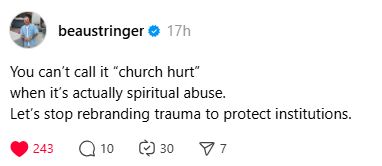
The pain of being ignored in public by people at the church was too much, so just shy of a year after this, my family moved to Kansas City. For two years now I’ve been trying to get in as a pastor of a church, to help people understand Jesus as the lover of our souls who walks with us even when things make no sense and don’t seem to be changing for the better. But no one wants this. They only want the conquering, nationalistic, caricature of Jesus.
Rachel Held Evans summarizes my point throughout this section:
Madeleine L’Engle said, “the great thing about getting older is that you don’t lose all the other ages you’ve been.” I think the same is true for churches. Each one stays with us, even after we’ve left, adding layer after layer to the palimpsest of our faith.5
But I can tell my own story, which studies suggest is an increasingly common one. I can talk about growing up evangelical, about doubting everything I believed about God, about loving, leaving, and longing for church, about searching for it and finding it in unexpected places. … I can’t provide the solutions church leaders are looking for, but I can articulate the questions that many in my generation are asking. I can translate some of their angst, some of their hope.6
Present Wrestlings
So I keep writing. I keep going to therapy to work through these feelings. I keep reading my Bible and praying. The word I keep hearing from God is “Trust me.”
It’s a word I’ve been hearing for ten years. It’s the word that led me to leave a terrible counseling situation.7 It’s the word that led me to respond to the gospel-confused pastor. It’s the word that led me to love people a church wanted me to shun. It’s the word that’s led me to wonder if God is safe to trust.
And you might think, “If you trusted God, you would have kept your head down and your mouth shut.”
Maybe. But everything I’ve seen in the Bible is that true faith—real trust in God—tests him, acts, moves forward, knowing the only thing to catch us if we fall is God.8 Plus, like Jeremiah 20:9, if I keep my mouth shut, it becomes a burning fire inside. I have to speak the words God has given me. To not is to betray that I don’t trust him.
And as Rachel Held Evans wrote, “No step taken in faith is wasted, not by a God who makes all things new.”9
And it’s possible in certain other areas I’m still not trusting him and that’s why he’s still telling me to trust him, but I’m tired. My mind tells me, “‘Trust me’ is a cop-out. How do you know when you have trusted enough?”
I mentioned above that I wrote a thesis for my Master’s degree. This process broke me. My thesis was focused on Old Testament allusions in Titus 2:14, but in order to write this, I read a lot on how the early church read the Bible. A good amount of what I read was incompatible with what I’d learned at church.
Admittedly, I’d heard similar things while working on my Bachelor’s degree, and I’d poo-pooed them in the name of standing for orthodoxy, but now I was hearing it again (testimony of two or three witnesses?). I was really only able to put these thoughts into words earlier this year after reading two books by Peter Enns: The Sin of Certainty and How the Bible Actually Works. The Bible cannot be simplified into a rulebook for life or even a systematic theology. It resists both of these pursuits.
But today I read Isaiah 26—a real roller coaster of a chapter (seriously, go read it)—and verse 3, like usual, stuck out to me because of all these thoughts. (I’m writing this paragraph on October 18; I started writing this post on September 22.) Verse 3 has been a precious verse to me for more than 5 years now:
You will keep the mind that is dependent on You
Isaiah 26:3, HCSB
in perfect peace,
for it is trusting in You.
Maybe there’s something to the thought that I’m all flustered because I’m not trusting God? Maybe that’s why there was no question in my mind that I was on the right path in the decisions leading up to my excommunications? Perfect peace is the result of active trust in God.
Note that Isaiah 26:3 does not say anything about God’s Word. God expects our trust to be in him—not the Bible. But how do I demonstrate active trust in God?
- Is it by remaining in my current line of work that barely pays the bills?
- Is it by pursuing a new career?
- Is it by quitting my job and pouring all my energy into starting a business?
- Is it by taking out more loans and starting a PhD program so I can teach the Bible at the university/seminary level?
- Is it continuing to pursue pastoral ministry?
- Is it going back to school to become a counselor/therapist?
- Is it some combination of these options?
But even if I step out in faith in one or more of these arenas, it doesn’t help my perspective on God. I know I need to trust God, but who is the God I’m supposed to trust?
- Is he loving and kind?
- Or is he angry and incensed every time I mess up?
- Is he in control of all things?
- Or did he create free agents who are allowed to make choices?
- Did he give me the stroke I had at age two?
- Or did he allow it to happen for some unknown reason?
- Or was he not strong enough to stop it?
The Bible doesn’t have a nice answer for these questions, other than the reality: “God is love” (1 John 4:8, 16). Nowhere does the Bible make a metaphysical claim, “God is wrath,” like it makes of love.
And God proves his love on the cross (Romans 5:8). God died on the cross. So this should be my starting point for learning about him. It’s the basic gospel message—the message that got me kicked out of a church for asking for. Christianity has survived 2,000 years because of this message. It should keep me afloat and inform the rest of my theological musings.
Rachel Held Evans again (quoting an excerpt from Lauren Winner’s memoir):
“What you promise when you are confirmed is not that you will believe this forever. What you promise when you are confirmed is that this is the story you will wrestle with forever.”10
The Way Forward
So I will continue on in faith. I will continue to claim Christ as my Lord and Savior and homeboy and friend. I will continue to wrestle with Scripture deeply in my study/various coffee shops, applying it to my life and sharing my insights with you as well. I will make myself available to hear others’ doubts about Scripture and faith and not beat them over the head with Bible verses and the fear of hell. I’m walking by faith, even though my eyes are telling me to give up, and if this means going against evangelical convictions, so be it.
I must obey God rather than man.
I’d love for you to join me in this journey.
I’d love to hear your story, your doubts.
In this with you.
Thanks for reading!
While I am committed to providing theological reflections at no charge, your paid subscription makes my writing possible and helps me reach more people with the gospel of God’s love. If you’re not currently a paid supporter, please consider becoming a supporter today.
Notes and References
- “Look in the mirror and tell the truth about what is happening around you, to you, and in you. Tell the truth. In order to learn how God is getting your attention, tell the truth” (Jamie Winship, Living Fearless: Exchanging the Lies of the World for the Liberating Truth of God [Grand Rapids, MI: Revel, 2022], 45). ↩︎
- If you click the link there, the pertinent discussion is on Jeremiah 20:7, on pages 5–7. ↩︎
- The linked post above was the catalyst for this—along with reflections on 1 Kings 12:25–33 that I still need to put into writing. ↩︎
- I looked at the pertinent texts exegetically; I weighed the church’s practice throughout history; I questioned the wider theological consequences of this position; I dove deep into ecclesiology (the doctrine of the Church); I looked into it psychologically; in a word, I uncovered as many rocks as I could think to uncover. ↩︎
- Rachel Held Evans, Searching for Sunday: Loving, Leaving, and Finding the Church (Nashville, TN: Nelson Books, 2015), 179. ↩︎
- Ibid., xiii. ↩︎
- See discussion in Joshua Wingerd, Live Free or Die Lawfully: A devotional commentary on Galatians (Victorville, CA: FYTR Publishing, 2019), 137–138. ↩︎
- “Only a real risk tests the reality of a belief” (CS Lewis, A Grief Observed [New York: HarperOne, 1994], 23). ↩︎
- Held Evans, Searching for Sunday, 180. ↩︎
- Lauren Winner, Still: Notes on a Mid-Faith Crisis (New York: HarperOne, 2013), cited in Held Evans, Searching for Sunday, 194. Emphasis added. ↩︎
Buy Me a Coffee
Choose an amount
Or enter a custom amount
Your contribution is appreciated.
Donate
2 thoughts on “Can I Be Honest?”