
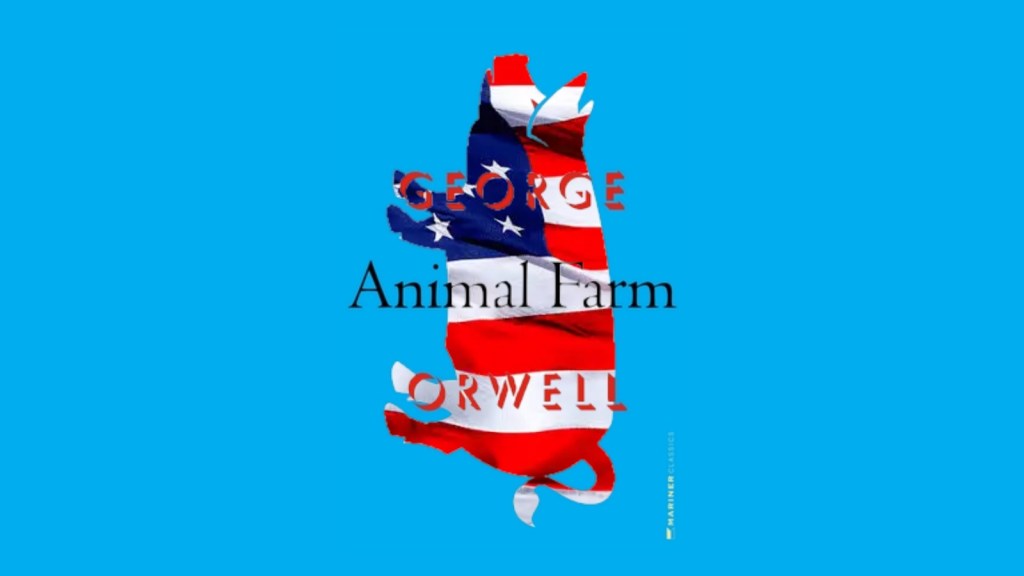
George Orwell’s Animal Farm1 is not about Communism. Sure, it speaks to Communism, but it is not so narrow in its focus and application.2 This book is a fable about the corruption of power, but power corrupts in more realms than politics. Power corrupts religion. It corrupts families. It corrupts interpersonal relationships.
As a fable, it is meant to be applied. We ignore this book to our own peril. We explain away this book to our own peril. We ban this book to our own peril. Because it will be applied whether we want it to or not—if we are not taking active steps to prevent it.
There are four specific points in Animal Farm that illustrate the corruption of power.
First, before power can be corrupted, there must be a space for power to be exercised. We see this in the opening chapters. Old Major, the pig, has a vision of a revolution—the animals throwing off the shackles of man. Then they carry out this revolution. The animals kick Farmer Jones off his farm, rename the Farm after themselves (“Animal Farm”) instead of Farmer Jones’ possession (“Manor Farm”), and try their hand at self-government.3 Snowball and Napoleon emerge as two potential leaders emerge—both are pigs. “It was noticed that these two were never in agreement: whatever suggestion either of them made, the other could be counted on to oppose it” (p. 26). “These two disagreed at every point where disagreement was possible” (p. 43).
Second, in order for power to be solidified, the other side must be vilified. Snowball wants to see “innovations and improvements” (p. 44), being careful in his research and earning the support of the other farm animals (p. 43). Napoleon wants to see more food production and the opposite of whatever Snowball puts forward (p. 46).
The animals formed themselves into two factions under the slogans, “Vote for Snowball and the three-day week” and “Vote for Napoleon and the full manger” (p. 46).
Snowball has the wellbeing of the animals in mind. Napoleon’s desires, by contrast, are initially unclear; he only wants to stand against what Snowball stands for. However, as Napoleon begins cooperating with the humans, it becomes clear that he only has the reputation of the farm in mind. Not for the animals’ benefit though—for productivity and profit. Eventually, Napoleon forces Snowball out and spreads nasty rumors and lies about him. Snowball essentially has a bounty put on his back if he ever returns to the farm. Animals are publicly slaughtered for “supporting” Snowball (pp. 74–76). Thus, the other side of the aisle is villainized, and if the other animals want to fit in and prosper, they must agree with Napoleon and keep their concerns to themselves.
Boxer the horse is an example of an animal that recognizes the problems going on, but is scared into silence. He does not want to stir up trouble (pp. 72–73). He trusts that the pigs will take good care of their most faithful worker when he gets injured while going the extra mile in his work. Napoleon assures him he is headed to the best doctors, but as the truck drives away, the other animals notice what is written on the truck: “Alfred Simmonds, Horse Slaughterer and Glue Boiler, Willingdon” (p. 108). If a profit can be made, why sacrifice money to help instead? Silence in the face of oppression benefits no one.4
Third, all leaders need loyal supporters. A specific type of animal is especially responsible for the solidification of Napoleon’s power. Admittedly, Orwell is a little bit on the nose when he identifies the unquestioning loyalists as sheep,5 but the sheep go around repeating the party line: “Four legs good; two legs bad” (p. 43). And when the party line changes—contradicting the previous—the sheep go on repeating it, unquestioningly: “Four legs good; two legs better” (p. 118).
The final step in the corruption of power is when the new regime is indistinguishable from the old one. At the end of the book, the pigs are sitting at a table inside with humans, and as the other animals look in, they can’t distinguish the pigs from the humans. “The creatures outside looked from pig to man, and from man to pig, and from pig to man again; but already it was impossible to say which was which” (p. 124). Now the people’s leader looks like the king they booted out when their government began.
How have you seen this story play out in your own life?
How have you seen this story play out in your world?
How will you resist?
In this with you!
Thanks for reading!
Notes and References
- The page numbers I cite throughout are from the illustrated edition: George Orwell, Animal Farm, Harcourt Brace Modern Classic (New York: Harcourt Brace, 1982). ↩︎
- “Orwell wrote Animal Farm as a satire of the Russian Revolution, but also one against any violent conspiratorial revolution that only leads to a change of masters” (Ksenya Kiebuzinski and Petro Jacyk Resource Centre, “Not Lost in Translation: Orwell’s Animal Farm Among Refugees and Beyond the Iron Curtain,” p. 4). ↩︎
- I can’t help but wonder if Orwell didn’t have the United States (or even England) in mind when he published his book. “Animal Farm” is parallel to the concept “of the people,” “Revolution” is what gives birth to the farm, and “Manor Farm” highlights subjects who are ruled, like in medieval feudalism or the American Colonies. Orwell was British; he published his book in 1946, following the end of World War II. There are pictures of President Franklin Roosevelt and Winston Churchill sitting with Joseph Stalin at the Yalta Convention in February 1945, which helped give birth to the USSR. Orwell was critical of the Atomic bomb, which he argued would “complete the process by robbing the exploited classes and peoples of all power to revolt, and at the same time putting the possessors of the bomb on a basis of military equality. Unable to conquer one another, they are likely to continue ruling the world between them, and it is difficult to see how the balance can be upset except by slow and unpredictable demographic changes” (George Orwell, “You and the Atomic Bomb,” Tribune [October 19, 1945]). ↩︎
- Pastor Martin Niemöller said, “First they came for the socialists, and I did not speak out—because I was not a socialist. Then they came for the trade unionists, and I did not speak out—because I was not a trade unionist. Then they came for the Jews, and I did not speak out—because I was not a Jew. Then they came for me—and there was no one left to speak for me” (United States Holocaust Memorial Museum). ↩︎
- It appears that this usage of “sheep” has been around for centuries, beginning as early as Erasmus in the 1500s; Shakespeare puts it in the mouth of Julius Caesar in the next century (Oxford English Dictionary, s.v. “sheep (n.), sense 5.a,” December 2024, https://doi.org/10.1093/OED/7943173625). It could have originated with the Bible, but there are no records of this pejorative usage of the word prior to Erasmus in the 1500s. This would make for a fascinating dissertation topic, tracing Greek and Latin usage of this word over time, seeing if any opponents of Christianity used the term of their movement in the first 1500 years. ↩︎
